How Do We Know About God?
Grown-ups: Read this aloud with your Bible open. It takes about 20 minutes, and you can split it over a few days. You'll need a Bible, crayons, and the printed coloring page. Stop whenever your child asks a question, because that is the lesson working.
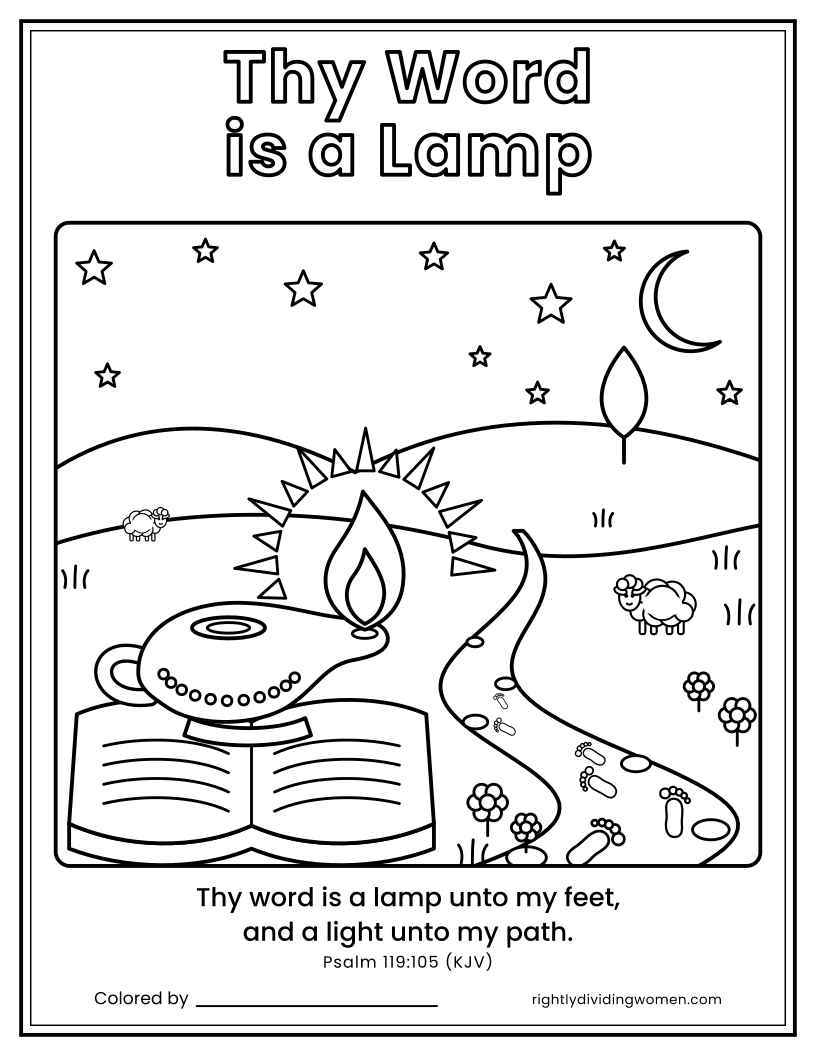
Thy word is a lamp unto my feet, and a light unto my path. Psalm 119:105 · KJV · Our memory verse
Today's big word
Biblio means book. -ology means the study of something. Bibliology means studying what the Bible says about the Bible. Say it three times, as fast as you can. Now you know a word most grown-ups don't, so be kind about it.
Here is why we start with it. You can't see God with your eyes. So how can we know what He is like? God told us. He gave us a Book.
The king who burned the Bible
Read it together: Jeremiah 36:21–23 and 36:27–28.
A long time ago, God told His prophet Jeremiah, "Take thee a roll of a book" (Jeremiah 36:2). A roll was a scroll, one long sheet rolled up like a paper towel. Jeremiah said God's words out loud, and his helper Baruch (BAIR-uk) wrote down every one.
God's words carried a warning for the king: stop doing wrong and turn back to Me. So the scroll was brought to King Jehoiakim (juh-HOY-uh-kim). It was winter, and the king was sitting by a warm fire. A man named Jehudi began to read it to him.
Did the king listen? He did not. After a few columns, "he cut it with the penknife, and cast it into the fire" (Jeremiah 36:23). A penknife is a tiny knife for sharpening pens. Slice, toss. Slice, toss. He kept going until the whole scroll was gone, and he wasn't even afraid.
Now, here is the question. Did that get rid of God's Word?
God said to Jeremiah, "Take thee again another roll, and write in it all the former words" (Jeremiah 36:28). So they wrote it all over again, and God added even more (Jeremiah 36:32).
Look down at your Bible. You just read that story, about the scroll he burned, in the Book he could not burn. Nobody remembers that king's birthday. "The grass withereth, the flower fadeth: but the word of our God shall stand for ever" (Isaiah 40:8).
Ask and answer
Grown-up asks. Child answers. Do it again tomorrow, and they'll have it by Friday.
- Who gave us the Bible?God did. He used men to write it down.2 Timothy 3:16 · 2 Peter 1:21
- Is everything in the Bible true?Yes! God cannot lie.John 17:17 · Titus 1:2
- Can anyone get rid of the Bible?No! God's Word stands for ever.Isaiah 40:8
- Who is the Bible about?It is all about Jesus.John 5:39 · Luke 24:27
Say it: thay-OP-nyoo-stoss. Paul wrote, "All scripture is given by inspiration of God" (2 Timothy 3:16). That whole phrase "given by inspiration of God" is one Greek word. Theos means God. Pneō means to breathe. It means God-breathed.
Try it: Hold your hand in front of your mouth and say, "God gave us His Word." Feel that? Your words ride out on your breath. The Bible's words came out from God like that. Moses and Paul held the pens, and "holy men of God spake as they were moved by the Holy Ghost" (2 Peter 1:21). Spake is the King James way of saying spoke.
Learn the verse with your whole body
In Bible times there were no flashlights. People carried a little clay lamp with oil and a tiny flame. It didn't light the whole road. It lit up the next few steps, and that was enough to walk safely in the dark.
- "Thy word" Open your hands like a book.
- "is a lamp" Cup your hands around a flame.
- "unto my feet" Point to your toes.
- "and a light" Throw your fingers open wide.
- "unto my path" March in place.
The best part of the whole Book
Jesus said the Scriptures "are they which testify of me" (John 5:39). Testify means to tell the truth about someone. The Bible tells us something sad and something wonderful.
The sad part is that "all have sinned, and come short of the glory of God" (Romans 3:23). That means you, me, and King Jehoiakim too. The wonderful part is that "Christ died for our sins according to the scriptures," He was buried, and "he rose again the third day" (1 Corinthians 15:3–4). John tells us why he wrote it all down: "that ye might believe that Jesus is the Christ, the Son of God; and that believing ye might have life through his name" (John 20:31).
Three questions for the table
- Why do you think the king didn't want to hear God's words?
- What did God do after the scroll burned? What does that tell you about God?
- Was there something you heard in the Bible this week that was hard to hear? What should we do with those parts?
Thank God for telling us about Himself. Thank Him that no one can ever get rid of His Word. Ask Him to help you love it, and to help you believe what it says about Jesus. Then let your child pray in their own words, even if they mostly thank Him for the dog.
Your coloring page
Follow the footprints! Who do you think is walking on that path? Where is the light coming from? Color the lamp's flame the brightest thing on the page.
Make a scroll you can eat
God once showed the prophet Ezekiel a scroll and told him, "eat this roll" (Ezekiel 3:1). It tasted like honey. So we're making Ezekiel's Honey Rolls, and no real books will be harmed.
Find a Bible that belongs to you and write your name in the front, with a grown-up's permission and a nice regular pen. Tonight, turn off the lights, read Psalm 119:105 by flashlight, and walk to your bed by that little light.